Thursday, February 28, 2008

The Ghats of Varanasi and Goodbye to India

Well, here it is - the final entry of my India trip.
I arrived in Varanasi at 9:00 AM on the overnight train, on which I slept like a baby. I took a cycle-rickshaw into the old city near the ghats, where most of the guest houses are located, and quickly found a place to stay for the 2 nights I would be there - I've been more free with my money toward the end of this trip, because I've budgeted enough previously that I'm in no danger of running out. I left my stuff in my room and then had a breakfast at the hotel, where the manager whipped out a guestbook filled with positive comments left by people who had gone on the hotel's boat trip and city tour in the mornings, and then asked me if I'd like to go. It was only 250 rupees, and a boat trip down the river and a walk down the ghats were the only 2 things I had really planned on doing in Varanasi, so I agreed, and he said he would come wake me up at 5:30 before the tour at 6:00 the next morning.
Well, I woke up the following day at 7:30 AM and wondered what the heck happened to the wake-up call. I went down into the reception area, and asked about the boat trip. I didn't get a clear answer about what happened with it, but the manager apologized and said I could go the next morning instead - I wouldn't be able to do the city tour because my train left for Delhi at 11:20, but I still really wanted to do the boat trip at dawn, so the guy reassured me he would wake me up the folowing morning.

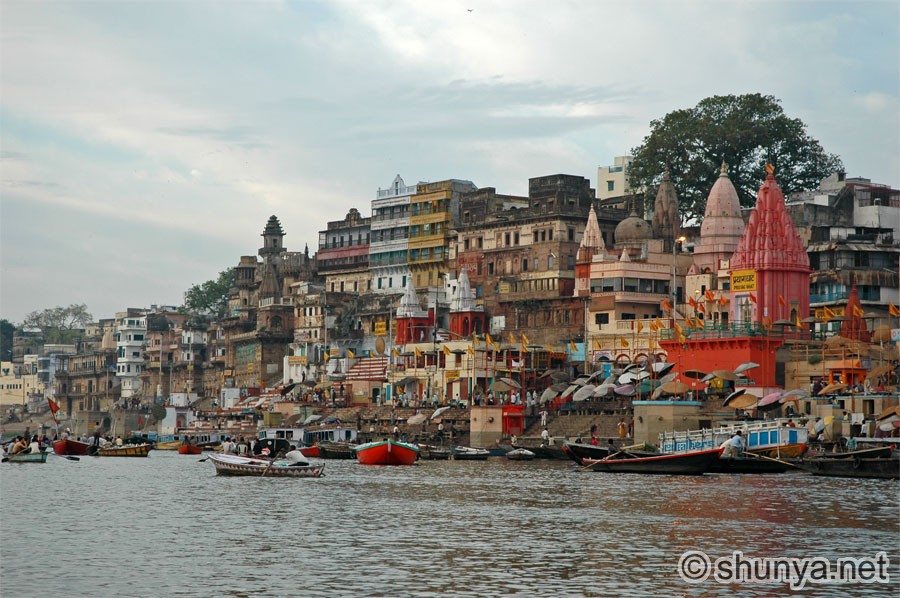
That day, though, I took a trip down to the ghats. Located on the Ganges River (worshipped as the personified form of the goddess Ganga), the sacred city is the beating heart of the Hindu universe. The city's ghats are its most distinctive feature - sets of steps and built leading down to the river, where Hindus come to wash clothes, hang out, do yoga, perform religious rituals, or scatter their loved ones' ashes in the current, thus liberating their souls from the eternal cycle of life and death. That day I decided to walk along the entire length of the river's banks near the city, going from ghat to ghat starting at the southernmost, Assi Ghat, and working my way north. The moment I stepped out onto the first stone shelf and saw the stairs going down into the sprawling Ganges as it slid by, I told myself, I am so glad I didn't leave India without seeing this. I strolled along the ghats for several hours, pausing for long stretches to sit down and take in the soul-soothing atmosphere, watch the locals at the water's edge or watch them cremate corpses at the special burning ghats. Walking along the ghats was a unique and beautiful experience, one I felt like doing again right after I finished.

I took a cycle-rickshaw back to my hotel after, then got some dinner and went to bed pretty early. I woke up in the morning and looked at the clock - 7:40! Gah! I could have punched a hole in the wall, I was so frustrated - no dawn boat ride for me in Varanasi, one of the experiences I had been looking forward to most. There was nothing to be done for it, though, so I decided not to make a fuss when I went down and had breakfast. Then I went and stuffed all my things into my backpack (now seriously overfilled because I bought stuff for family and friends in Kolkata), paid and checked out of the hotel and took a cycle-rickshaw to the train station where my train departed on time at 11:20.

I usually try to take night trains because it cuts down on hotel costs and it allows more daylight hours in cities, but I ended up taking a morning train to Delhi because I didn't book the ticket until two days before. I was extremely fortunate to get one at all. It actually wasn't such a bad thing, anyway, because the trip was a 17-hour monstrosity and I really appreciated being alone in the car for the first few hours. The ride was really quite a good way to spend the day, sunshine outside on the green countryside sprinkled with yellow flowers, the windows open and the wind blowing throught the car, and I listened to both Plans and Transatlanticism by Death Cab For Cutie.

I didn't sleep that well overnight, but our train pulled in Old Delhi train station at 5:30 in the morning. I was headed to Paharganj, the area Michael and I had stayed 3 weeks earlier, and I had a between an autorickshaw or a cheaper, slower cycle-rickshaw to get there, and I chose the latter. I gave the driver a big tip after he dropped me off because it was a long way and he'd worked his ass off huffing and puffing up those hills. The moment I started looking for a guest house a guy attached himself to me and said he wanted to help me find a place just "for friendship, no charge" and tried pulling me away to a bunch of other hotels. I resisted, and every place I went into I literally had to close the door in the guy's face because if he came in he would say he brought me and the hotel would be tacking his commission onto my room rate. I tried 10 or 11 places before finding a good lodging, and most of them wanted to charge me a full day's rate from 7:00 AM until noon, but I told them that was bullshit and most of them laid off when I said that, fine, I'd just carry my backpack around and be back at noon to check in.

Anyway, my plane leaves tonight at 11:55, and I've just been wasting time around Paharganj until then, walking around, buying a couple things for friends, journaling, spending time in email cafes, getting laundry done, getting my disposable cameras developed, and thinking about what my trip has been. I'm going to take a taxi to the airport at 8:00 - I hope my laundry is done by 5:00 like it's supposed to be.
So, my adventure is now at an end, and what a splendid adventure it has been. All last year during my senior year at Van I was yearning, painfully, to travel on my own and get out of the US, but I was stuck. Then I went to New Haven to do a DTS, which was a very welcome change, a great town where I made wonderful friends. We were going to Pune, India to wor at a children's home, which I was so happy about, but I still felt that 3 1/2 weeks in the same cushy YWAM outreach apartment wouldn't be nearly enough to hold me over once I got back - as I wrote in my journal, "I need to do some seriously adventurous shit before going back to Texas." And now, after 5 weeks of trains and buses and mountains and lakes and crappy rooms and Taj's and rickshaws and Indian cities, I've done what I was dreaming about for so long. I feel that for now I've scratched that ever-loving travel itch, that I'm finally ready to be with my family in a static environment, to love them and hug them and kiss them, and to start thinking about where my life is headed from here and how I can get it there.

That's one of the things I'm taking away from this trip the most - "following your dreams" is such a cliche inspirational phrase and seems like it should be relegated to bookmarks at the public school's library and movies by Walt Disney Studios, but it's true. I didn't have much time to plan this trip at all - I just had my ticket booked 5 weeks after the rest of the outreach team leaving from Delhi instead of Mumbai, and I didn't know where I would go, what to do, where to stay, if I had enough money, or if I would be able to take care of myself, but I took a leap of faith, and it has ended up being by far one of the greatest experiences of my young life. I'm not saying that recklessness and self-deceit are the way to go, but looking back over my trip I can see God in every single moment protecting me, comforting me, preparing a way and showing me his beauty. My God is my shepherd and I shall not want. Praise him, praise him, this is a beautiful world.

Monday, February 25, 2008

Bodhgaya, Kolkata, and Missionaries of Charity

Sorry I haven't posted in a while - these things take a long time to write! Anyway, this is the part of the journey where I deviated from my original course. When I was in Pune planning my trip, I had intended to strike out north after Delhi to the Golden Temple of Amritsar and the Himalayan villages of Manali and Mcleod Ganj. This was all well and good until we were in Goa and I was appreciating how perfect the weather was and I thought "Gee, I wonder what the weather is like in the Himalayas in February?" and checked it out on the internet. Yikes. I didn't think sub-zero temperatures would agree with my distinctly "summer" wardrobe, and so I realigned my trajectory along the eastern compass point, through the cities of Varanasi, Bodhgaya and Kolkata. Those 3 cities are all lined up in a pretty little line from Delhi with Kolkata lying on the far eastern coast, so I decided to hit Bodhgaya on the way there and Varanasi on the way back (my plane home leaves from Delhi on the 28th).
My train ride from Delhi went as smoothly as possible, apart from a group of 7 to 8 men illegally climbing into our sleeper car and presumptuously sitting on my bed for 2 hours until the train guards game with guns and, yelled at them for a while and kicked them off. I read the entirety of Slaughterhouse-Five on the trip, and I slept well till the next morning when the train pulled into Gaya, the transport hub for Bodhgaya and the surrounding area. I pulled on my pack and walked down the stairs out of the station - the moment I did there was a throng of rickshaw drivers wanting to take me to Bodhgaya. One weathered old chap broke away from the group and bounded up the stairs to meet me before everyone else. I don't know if this was against their etiquette or something, but when we got to the bottom of the stairs on of the other drivers started screaming at him and nailed him across the face with a loud *POP*. It was about a 20-minute ride into Bodhgaya (the driver was muttering to himself all the while, probably about how young Indians these days have no respect), and once we arrived I started looking around for places to stay - I first tried a few of the monasteries which had acommodation for travelers, because I thought the tranquil setting would be a good place to relax and meditate and pray. However, none of the monasteries were open for guests at 8:00 in the morning, so I trudged along in the mud (it had rained the night before) and checked out some of the other hotels. I ended up at the Rainbow Guest House, an amiable place with a shocking pink color scheme in its lobby, where I napped and listened to music for a bit and then went out to explore the town.

Located in Bihar, India's poorest state, Bodhgaya is home to Buddhism's holiest site, the bodhi tree under which Siddhartha Gautama meditated for 6 weeks and attained enlightenment, becoming the Buddha. The tree draws pilgrims from all over the world, and built next to it is the towering Mahabodhi Temple, built by Emperor Ashoka in 250 BC, where reverent followers come to pray, chant, and meditate. The first place I went to was the bodhi tree, which is awe-inspiring to behold, given the incredible importance of the site in world culture and history. I simply sat there for a long time, enjoying the atmosphere and the shocking reverence devotees show for the tree, adorning the surrounding area with prayer cloths and scuttling over to delicately pick up one of the sacred leaves when they fall to the ground. While I sat there a man strolled over to me who looked like your classic Eastern spiritual man - lank white robes, long matted black hair and beard and a very spiritual, floaty gait. He sat down next to me and started talking about spirituality and meditation and happiness, so we took a walk together and sat down next to the lake adjacent the temple, where according to legend Buddha was sheltered from a violent storm by the lake's snake god. We chatted and ate what I now know was pomegranate (I'd only drunk the juice previously), and as we did so it became increasingly apparent that he fancied himself a sort of guru, that his "spiritual" appearance was no accident, and he certainly knew how to work wealthy young spiritual seekers - he pulled out a handful of email printouts from people who had learned from him, and sent him sums of money so he could continue to give guidance to others. He showed me a message from a Harvard student (according to the email address) who was sending him $150 USD a month. "His father is a very rich man," said the guru. And you are a genius, Mr. Guru.

On my second day in Bodhgaya there was a party happening on the roof of my guest house, the grand opening of a weekly french fry and beer bar run by two jolly Belgian fellows. I mustered up the courage to go and check it out, being alone and not knowing anyone. I was my typical self for the first 10 or 15 minutes, incredibly awkward (it was my first "real" party, with cigarettes and alcohol and marijuana and all that), but eventually I got talking to some people and it ended up being a fantastic time. I was overwhelmed by how many interesting, friendly people were there, world travelers from all over the globe (I was the only American) speaking a slew of languages, and everyone had fascinating stories to tell about their lives and their travels. I was by far the youngest - everyone else was at least 7 or 8 years my senior - and they were amazed to hear that I am 18 and traveling alone. It was just a delight listening to them, people who have led such amazing lives, and I had a splendid conversation with a 25-year-old French-Canadian woman who lives in Rishikesh with her Indian husband. She really encouraged me about my dreams, and her talk about pride in being American (in the sense of "the Americas", not the USA) shifted my thinking and gave me a bit more pride myself. Everything that night was just so wonderful and rosy (the beer might have been a little part of this), and I zonked out in bed that night happier than I had been in a long time.

My next few days in Bodhgaya were super chilled-out, just a time to read a lot and pray and walk around. There isn't all that much to do in Bodhgaya, per se, because despite the fact that it's a major pilgrim and tourist destination, it's still really just a rural town, but there are good cheap restaurants all over and a calm atmosphere pervading the place. On my last day, though, I did get to visit a public school in the area, started and overseen by a delightful older Scottish man named Edan, who I met at the party. He's really an amazing guy - builds boats in Scotland for part of the year, and travels and does social work around India and other developing countries for the rest of the time. Meeting him was a real encouragement - I was under the impression that most people got burnt out social work and solving the world's problems before they were 35. I thought Michael Caine had stepped right out of Children of Men. Anyway, he invited me to come to his school, where they were going to perform a puja (essentially an offering to the gods, and an important part of Hindu culture) for Saraswati, the goddess of wisdom and knowledge. It was really fascinating to witness, and watching them perform the labyrinthine rituals involving manifold powders, foods, fabrics, incense and liquids reminded me that a whole lot of Hinduism is just completely off-the-wall crazy.

I departed Bodhgaya on the 12th, and realized a few minutes after arriving at the train station that I left my scarf I bought in Udaipur for 400 rupees in my room (damn it!). My train to Kolkata (for those of you wondering about the city name, the spelling was changed from "Calcutta" to a more phonetical spelling in 2001) arrived fashionably 2 hours late, and I couln't fall asleep for the first 2 or 3 hours of the ride, not because of the cacophonous snorer below me, but because for some reason my bed was 4 or 5 inches shorter than regulation and didn't quite accommodate all 6 feet of me. I got off the train and took one of Kolkata's trademark large yellow taxis to Sudder St, the indisputable epicenter of tourist- and foreigner-accepting lodging in the city, packed with cheap continental food, guest houses and handicraft shops. I got a decent room pretty quickly (actually, it was on the 4th floor of a building, up a laborious flight of stairs) then collapsed on the bed, exhausted from lack of sleep on the train. For the next 2 days I spent much of my time in my room or in the cafes on Sudder St, half because being alone in a city as enormous as Kolkata makes it difficult to break into and begin to figure out, but also half because in Bodhgaya I had traded some old books for The Road by Cormac McCarthy, and it had me completely gripped. It was a gorgeous book, and I highly, highly recommend it.

On my third day, though, I visited the Motherhouse, the volunteer center for Mother Teresa's Missionaries of Charity, to find out about when I would be able to help out. They told me to come back on Monday, Wednesday or Friday at 3 PM, so I disappointedly checked out the displays tracing Mother Teresa's life, as well as her tomb and her sparsely furnished bedroom. Walking around the place, I was actually a little bit turned off by the sort of off-putting glory given to "Mother" by the nuns and people there - the sculptures and paintings adorning every corner, the people praying to her at her tomb. I don't think it's what she would have wanted, and I don't think it's what God wants, either. I started chatting with a pair of friendly Swedish chaps also visiting the Motherhouse, and we decided to hang out - we went first to one of their homes for orphaned children, and any cynicism or pretension that had been planted at the Motherhouse melted away at the first sight of one of the Sisters cradling a baby born blind who was found lying abandoned on the road - they do beautiful, important work there, and it touched me deeply.

Me and the 2 Swedish guys, Anton and Mikael, walked after that to the Victoria Memorial, one of Kolkata's most recognizable monuments. Built buy the British Raj, the Memorial is so imperial it would make Emperor Palpatine proud, but today it serves as a museum and park area for romantic Kolkatans to canoodle under the trees and bushes surrounding the many park's many ponds. The structure itself is nice (everything else seems a bit bland after the Taj), but the park is nicely-tended and a good place to sit and read for the day. After that we went back to the Sudder St area and walked around New Market, Kolkata's teeming shopping center, which has an underground 4-floor mall busting at the seams with handicrafts, saris and fabric and super-annoying touts trying to pull you over to "come look my shop, nice cheap price". After that Mikael and Anton and I got pizza at Domino's, which was tasty, then said bye for the day.

We ended up hanging out together for the next day, as well, mostly in the New Market area, and they flew back to Delhi the next day (they only came to Kolkata for 1 1/2 days! By air!). They were incredibly nice guys, though, and hanging out with them helped me get a feel for the city making me much more eager to explore it on my own. On Monday I attended the meeting for volunteers at the Motherhouse, got orientated with how the mission works, and registered to work the morning and evening shifts on Tuesday, Wednesday and Friday (Thursday is the rest day for volunteers). On the way out of the Motherhouse I met two friendly young women, an Israeli and a Swiss-German who were also volunteering. We started talking and then took a taxi to the city's planetarium and watched their mediocre star show. The best part of the show was that it was narrated by an elderly woman who was indignant every time someone would turn on their cell phone during her presentation. We had dinner together and agreed to take a taxi to the Motherhouse together the next morning for our first shift of work.

We got to the Motherhouse at 7:00 in the morning, where all the volunteers gather to pray, sing and have breakfast together before departing to their respective workplaces for the morning shift. In the morning I worked at Daya Dan, the home for mentally handicapped boys. I was at a loss for how to help out for the first day, but after a while you get a feel for how things work, and you just see things that need to be done and do them - dressing the kids in the morning, getting them showered, taking them to the toilet when necessary, doing exercises with the more disabled kids to work their muscles, and keeping them relatively quiet and attentive during their lesson. And then there's prayer, which pretty much involves holding the kids facing the Virgin Mary as much as possible and singing and clapping their hands for them. It's bedlam. The kids are difficult to work with almost all the time, and taking care of them is a completely different ballgame from dealing with "normal" youngsters, but it's a pleasure to be with them and serve them, even if they can't appreciate it themselves. Especially inspiring are the Sisters, who literally give their lives for these kids.

In the evenings I worked at Kalighat, or Nirmal Hriday, the famous Home for the Destitute and Dying. Working there was a completely different kind of experience, since most of the patients who are brought there don't have anyone else in the world, and they come to the home to die. Kalighat's aim is not as much to save lives (though they try), but rather to give love and dignity to people who have had none in their lives. It's a quiet place, and the volunteers' duties are much more laid-back than at any of the other homes - changing bedpans and urine bottles, washing clothes and dishes, giving and administering medication, handing out food, and feeding the patients if need be. Looking at the patients there, who have seen so much suffering in their time, and suffered so much, all you really want to do is ease that pain as much as you can and give them the respect and love they deserve. It's a difficult job to do day-in and day-out, seeing life and death before your eyes and the hazy line that's in between, but the Sisters and the long-term volunteers serve with grace and love shining from their faces - and their hands.

I will never forget one man who I spent time with there. I was giving pills to patients, and was given a pill and a bed number to take it to - he was sleeping, an old man, shrivelled and emaciated. I roused him, but he didn't give a sign that he knew I was there - his eyes rolled in their sockets and then flicked back to center, foggy and unfocused and looking at nothing. I tried to tell him that it was time for his medicine, but everytime I brought the pill to his mouth he would moan and turn his head to the other side. I asked someone to help me, a kind Norwegian man named Magne, and he tilted the man's head forward while I put the pill on his tongue and poured some water in his mouth. He drank it, with some difficulty, and after we laid him back down and arranged a more comfortable sitting position for him with some other blankets. We just sat with him for a while as I gazed at him - he was so gaunt I couldn't believe that he was able to move his skeleton arm, wrists half-an-inch thick, a body literally of skin and bone. He looked like a skeleton shrink-wrapped in brown wax-paper, his breaths coming so, so shallow. Magne took his wrist and felt for a pulse, then gave the arm to me - the light pump of blood was barely perceptible under the fragile skin. Then he words I'll never forget - "He is dying," so obvious, but so terrible in their truth. Soon that man would exhale the last of those shallow breaths, and that sad excuse for a body would be cold and rigid, maybe that night, maybe the day after that, but soon. And he knew it, too. I wanted to comfort him, to do something more, but all I could do was sit there next to him and hold his hand.

Sadly, I only got to work at Missionaries of Charity for 3 days, but it is something I am so glad I did, a great experience, and there were more than a few moments that I will remember for the rest of my life. I left Kolkata on the 22nd, after a wonderful week and a half there. I really love the city, crowded and dirty as it is, and it's got so much flavor and life in it that you can't help but enjoy yourself. Despite the fact that it's known for its poverty, it's the cultural capital of the country, and it's a daily festival of human existence every way you turn, one of my favorite cities in the world. Note to anyone going to Kolkata: try one of the city's trademark "Kati Rolls" - you won't regret it.
Leaving Kolkata, I was feeling good, headed to the sacred Hindu city of Varanasi, the second-to-last city on my route before the end of my trip.

Sunday, February 17, 2008

Justin's Honorific Film Awards 2007

Yeah, so I'm travelling in India, but that doesn't mean I've stopped thinking about movies night and day! It's awards season for the year 2007, and it's the first year I've actually seen a majority of the films nominated (hooray for living within walking distance from a theater!), so I can't wait to see who gets honored. My picks are by no means definitive because there are a bunch of movies I didn't get to see, but I put a lot of thought into these choices, so I hope you enjoy.

BEST PICTURE
Atonement
Into the Wild
Gone Baby Gone
Juno
No Country For Old Men

BEST DIRECTOR
Wes Anderson, The Darjeeling Limited
Brad Bird, Ratatouille
The Coen Brothers, No Country For Old Men
Andrew Dominik, The Assassination of Jesse James by the Coward Robert Ford

BEST ACTOR
Russell Crowe, 3:10 to Yuma
Ryan Gosling, Lars and the Real Girl
Emile Hirsch, Into the Wild
James McAvoy, Atonement

BEST ACTRESS
Ellen Page, Juno

BEST SUPPORTING ACTOR
Casey Affleck, The Assassination of Jesse James by the Coward Robert Ford
Javier Bardem, No Country For Old Men
Hal Holbrook, Into the Wild
Tommy Lee Jones, No Country For Old Men
Geoffrey Rush, Pirates of the Caribbean: At World's End

BEST SUPPORTING ACTRESS
Ruby Dee, American Gangster
Jennifer Garner, Juno
Saoirse Ronan, Atonement
Amy Ryan, Gone Baby Gone

BEST ORIGINAL SCREENPLAY
Wes Anderson, Roman Coppola & Jason Schwartzman, The Darjeeling Limited
Diablo Cody, Juno
Nancy Oliver, Lars and the Real Girl
Simon Pegg & Edgar Wright, Hot Fuzz

BEST ADAPTED SCREENPLAY
The Coen Brothers, No Country For Old Men
Christopher Hampton, Atonement
Sean Penn, Into the Wild
Ben Affleck & Aaron Stockard, Gone Baby Gone

BEST CINEMATOGRAPHY
The Assassination of Jesse James by the Coward Robert Ford
Atonement
The Bourne Ultimatum
The Darjeeling Limited
No Country For Old Men

BEST EDITING
Atonement
The Bourne Ultimatum
Hot Fuzz

BEST SOUND
Atonement
The Bourne Ultimatum
3:10 to Yuma

BEST VISUAL EFFECTS
Harry Potter and the Order of the Phoenix
Pirates of the Caribbean: At World's End

Spider-Man 3
Transformers

BEST ART DIRECTION
3:10 to Yuma
The Assassination of Jesse James by the Coward Robert Ford
The Darjeeling Limited
No Country For Old Men

BEST NUDE FIGHT SCENE SINCE BORAT
Eastern Promises
Eastern Promises
Eastern Promises

MOVIE I WANTED TO SEE MOST BUT DIDN'T GET TO
The Diving Bell and the Butterfly
I'm Not There.
Persepolis
Sweeney Todd: The Demon Barber of Fleet Street
There Will Be Blood

Friday, February 8, 2008

Dizzying Delhi, The Tear Drop on the Face of Eternity, and A Parting

We departed Udaipur on the 16-hour bus ride to Delhi on the evening of the 2nd. Our experience was similar to the first trip, only we had much warmer garb, and this time we were sitting over the front axle and our driver liked to pretend he was driving a rally car, so we were jarred and bounced so much our denchers came loose. We got to Delhi in the morning, though, and made our way to Pahargang, the city's main strip for budget sleeping and eating. We got a crappy hotel for 400 rupees on the first day because we were too tired to look for anything else, but on the second day Michael went hunting, inquiring at every single hotel and guest house, checking out their rooms, haggling them down to their lowest price, then moving on to get an idea of the real cream of the crop. I would have thought this a bit too laborious previously, but I'm going to do it wherever I go now because he got us a great place for a mere 300 a night.

For our first 2 days in Delhi we hung around Paharganj's awesome bazaar and tasty eateries, also visiting Connaught Place, the heart of New Delhi (and consequently the purported "New India", as well), a metropolitan shopping center packed with McDonalds', T.G.I. Friday's and Western shopping chains, sadly almost devoid of trademark Indian charm. We had made it a goal to see a movie while in Delhi, and by sheer lack of options ended up in the very front row of National Treasure: Book of Secrets where the faces of the actors were so enormous I thought I might throw up. I thought the movie was a bit below average (then again, I have a weakness for treasure-hunting, relics, clues and incredible leaps in logic), and proved yet again that Jon Voight is neck-in-neck with Ben Kingsley for biggest Hollywood sellout, and will gladly attempt to lick his own scrotum on live TV if you pay him enough.

On our third day in Delhi, we had planned to make an excursion into Old Delhi, but Michael had a severe bellyache so I had to go alone. I decided to try and walk to Old Delhi to see the Jama Masjid instead of taking a rickshaw - I end ended up being pretty successful. I walked a long way into the bustling streets and frenetic bazaars (where actual Indians buy their clothes) before I was sure I would never find my way back or forward without some help, and I got a cycle-rickshaw to take me the last kilometer or so to the Jama Masjid.

Designed and built by the Mughal emperor Shah Jahan (whose opus was the Taj Mahal) in 1656, the Jama Masjid is India's largest mosque, and boasts magnificent architecture with a magestic archway at its posterior and long, low lines defining the walls of its serene courtyard, which holds a whopping 25,000 people. Entry to the mosque is free, but cameras cost 200 rupees to bring inside, and I'm a cheapskate, so I opted not to bring it in - however, once I saw the structure I started wishing I had smuggled it in somehow. The mosque is made all the more beautiful by the flocks of pidgeons which grace its domes and the floor of its courtyard. There is a tranquil pond in the middle of the courtyard where many people wash their feet or sit and relax, and I sat down next to it to read for a while and watch the people. Every once in a while, a child would barrel into the group of a hundred pidgeons milling around, and in a flurry of wing and feather they would all take flight and circle the courtyard, bringing a smile to the face of nearly everyone watching. But every time, the grumpy old fart in charge of the mosque's courtyard would run over and try to whack the imp with his stick, reminding us that old people, especially in religious institutions, are crotchety joy-killers all over the world.

I took a cycle-rickshaw back to Paharganj after the Masjid because I had zero idea of the way home. I am so happy, though, that I ventured into Old Delhi - it's more fascinating and has more pizzaz than most of New Delhi, and plus I didn't see a single other foreigner in my whole time there aside from at the mosque. When I got back to the room in the evening, Michael was a wreck, with his stomach in real pain, and he informed me that he probably wouldn't be able to go out to Agra to see the Taj Mahal the next day, even though we already had our train tickets.

In the wee hours of the morning on the 6th, when the wake-up call came from reception (it actually woke up Michael, who woke me - I'll sleep through anything), I started to get ready to go alone, until Michael said he had bounded back and was feeling well enough to risk going. Our train left from Nizamuddin, where many southbound trains from Delhi depart, so we had to take a taxi to get there, but once we did we got to our train on time and found it to be very empty and very cold. Michael and I were able to stretch out in our uninhabited cabin, and congratulated each other on choosing such a ridiculously early train, and I congratulated myself for bringing my blanket, which kept me nice and toasty. We arrrived in Agra at 9:30, and once we left the train station we were beseiged by rickshaw drivers wanting to take us to the Taj Mahal. We paid the standard 50 rupees and were whisked away to Taj Ganj, the area surrounding the Taj Mahal (vehicles aren't allowed within 500 meters of the Taj itself to keep pollution from harming it), where we got breakfast and then walked to the complex's east gate. We reluctantly paid the painful 750 rupee entry fee, then deposited our bags in the locker room outside (they don't even let books inside!) and went through the gate's security.

The architecture in the courtyard outside the Taj itself immediately recalls the Jama Masjid - both are obviously products of the same mind. As we approached the main archway leading to the actual Taj Mahal, I caught my first glimpse of the world-famous monument, and as we drew closer my mouth fell further and further open. As you would expect, the Taj is far more magnificent and beautiful than any picture could hope to convey. The attention to detail is simply mind-blowing. Every square foot is a true work of art, crafted by master artisans and marble-workers, but to see them all working together in such an enormous, cohesive whole is truly awe-inspiring. Constructed by Shah Jahan between 1631 and 1653, the Taj was built by the emperor to commemorate his love for his late second wife, Mumtaz Mahal - Jahan was so heartbroken after her death that his hair is said to have turned gray virtually overnight. On the inside of the structure lies a darkened maosoleum housing the ornate grave of Mumtaz, as well as Jahan, who was buried there later, offsetting the immaculate symmetry of the Taj. Walking around and admiring the monument's gorgeous desing and milky-white marble, one is struck by the fact that it exists for no other reason than to memorialize Jahan's great love for his dead wife - Rabindranath Tagore may have hyperbolized a bit when he called it "the tear drop on the face of eternity", but the Taj almost lives up to its colossal hype. It's an incredibly romantic tale and edifice - a love song sung in syllables of stone, and you couldn't possibly imagine a more beautiful building.
As we departed the Taj Mahal, I felt great about seeing it, as much for the actual experience and beauty of it as for being able to say I've been there and strike it from my life's to-do list. We hopped in the rickshaw and went out to find somewhere to eat lunch - our driver said he would take us to a good budget place he knew, but on the way we also stopped at another restaurant to check it out. We opened the front door and peeked our heads in, saw a man playing a sitar and a little boy dancing to it, and we immediately decided it was too ritzy for us, and hopped back in the rickshaw. Before we left, though, the restaurant's manager flew out the door and begged us to stay, that he would give us a special discount to 150 on a meal which is usually 375, to which we agreed. And it was a pretty swanky place, with smooth marble tables and scrumptious food, and it was fun looking around at the rich tourists dining there and think about how much they were getting screwed over for their 500 and 600 rupee meals. The only downside was that the guy with the sitar and his little boy dancer who wore heavy eyeliner and lipstick were making their rounds at the tables, and it was seriously freaking me out. Remind me never to let my 8-year-old be an exotic dancer at an Indian restaurant.
After lunch we decided to head back to the Agra train staion where our train left from at 4:10, but on the way our driver tried to divert us to tourist-trap marble-works shops where he gets commision, and Michael needed to make a stop at the Indian Airlines office to get his physical ticket from Delhi to Kabul changed to the next day. Our train ride back wasn't quite as the one on the way there - it took around 5 hours as opposed to the 3 it took to get to Agra, mostly becasue for the last 3 hours the train was going about 7 to 8 miles per hour. There is also no way to tell which station you're at other than asking other passengers - Indians have the innate ability to tell exactly which stop the train is at and how many more stops till yours without looking out the window or any external help. I really can't figure it out, but I know it's very mystical. We arrived back at the Nizamuddin station around 10:00, and a helpful guy told us we could save rickshaw money by just hopping on the train across the platform and hitching a ride in its free-for-all compartment, because its next stop was the New Delhi station, right next to Paharganj. We did, and it was an experience to say the least, one I'm glad I have, but it wasn't fun. It was standing-room-only, the car absolutely busting at the seams with people. We were also standing right next to the car's toilet, so we got the double blessing of the smell of people's butts wafting out of the toilet and guys constantly trying to squeeeeeze back and forth between the airtight bunches of people. I made sure my hands were firmly in my pockets to prevent any unauthorized borrowing, and it was a big relief when after 15 minutes we fell out of the train at New Delhi and Paharganj. Michael ate a burger on the way back (not the best remedy for an upset stomach) and we got back to the hotel a few minutes before midnight after an exhausting final day together and in Delhi. Michael packed his stuff up in his suitcase and arranged a taxi from the hotel to the airport in the morning, then as we fell asleep we told each other how glad we were we had travelled together, because we knew we'd be delirious at 5:00 AM.

At 5:00 we got up, took Michael's stuff downstairs and loaded it into the taxi, then we said bye, nothing fancy, and he left to go back to Afghanistan. I really am so glad I spent the last 2 weeks travelling with him, not only because I wouldn't have gone to Goa otherwise, but I learned a lot of stuff about travelling in India which wouldn't have been fun to find out myself, and it was just great getting to know him and talking to him about life, God, travel and filmmaking.

When I returned to the hotel room, my bag was the only one sitting there, and as I lay in bed under the covers I was overcome by the reality of being alone, profoundly alone. There is no one else for me to rely on now, I'm responsible for everything, and I have to watch my own back. Then, as a little bit of fear started to creep into my heart, I was reminded of the 23rd Psalm, that the Lord is my shepherd, I shall not want, and I shall fear no evil for his rod and his staff they comfort me - and my fear melted away, replaced by surpassing comfort. I lay in bed until 9:00, then got up, packed my backpack, checked out of the hotel and walked down the street to have a breakfast of muesli and chai. I wrote in my journal in the cafe there for a few hours, then got up, strapped my backpack on and walked down to the station where my train left from in an hour, truly excited for what lay further down the road.

Monday, February 4, 2008

Chillaxin' in Goa, Enjoying the Lake City of Udaipur

Sorry it's been so long since the last entry - we've been travelling and doing so much in such a short amount of time. Anyway, in the last post we had just arrived in Panaji, Goa and were about to check out the famous beaches of North Goa - in the morning we rented a scooter from the owner of our hotel and zoomed off on the narrow winding roads along the coast. Our first stop was Calangute, the southernmost and closest to Panaji. Upon arrival we decided it was not for us - its beaches were congested and overcrowded, and the town teemed with Indian partiers and overweight, sunburnt Europeans on their two-week package-tourism holidays. After we had a spot of lunch we consulted the Lonely Planet tome and decided to just go as far north as possible, to Mandrem, which was supposedly not quite so "discovered". Driving the scooter through the small villages and markets peppering the coastline was a blast, and we got to Mandrem about an hour later, just as the sun was starting to come down over its pristine, unspoilt beaches. Mandrem's look is idyllic, with the classic palm trees bending over and lining its long, wide stretches of sand, and we found it to be remarkably quiet and sparsely populated by sexy Euro-hippies. We immediately inquired as to the price of one of the beachfront's bamboo huts, and Michael was able to haggle one guy down to 350 rupees a night, and we deccided then and there to move our stuff out there from Panaji the next day. We left Mandrem at dusk, and it became increasingly dark as we drove home on the scooter (the headlights wouldn't turn on), making for a mildly terrifying ride back. Thank God for the occasional street light.
The next morning we packed up our stuff (I have a backpack and Michael has 2 large suitcases) and cut a deal with the hotel proprietor to let us hire the scooter for the rest of our time in Goa. We had to get a taxi to take our luggage to Mandrem, but we got to our beach hut around 11:00 on the 26th and had the next 4 days to just kick back and do nothing. Our time in Mandrem was just awesome - lots of relaxing on the beach, sunsets, fun on the scooter, long chats over meals at the numerous restaurants lining the waterfront, and time to exhale and contemplate after the 5-month DTS and time in Pune. It was such a wonderful time, in fact, that Michael and I have been exploring the possibility of returning for a summer to work at one of the restaurants in return for food and shelter on the beach. Here's hoping.

We left Mandrem, and Goa, on the morning of the 30th, taking a taxi to Old Goa's Karmali Station to catch our train back to Mumbai. We left at 11:00, and the trip was far more enjoyable for than the first one, mostly because of the complete lack of vomiting or diarrhea. We arrived in Mumbai late at night and immediately took a taxi to the Church Mission House where one of Michael's friends in the city had kindly booked us a room.

We slept well at the House, but left early in the morning for Mumbai's Central Bus Terminal to snag a sleeper bus to Udaipur. We bought tickets for the bus which departed at 11:00 from a kind of dense travel agent (he listed the departure times as "11:00 PM , 12:30 PM, 2:00 PM, 3:30 PM" and kept insisting they were correct after I questioned them), and then we went across the street to have some breakfast and wait the 2 hours till our bus left. When our bus finally arrived and hour and a half late (I don't blame them, traffic in Mumbai is a bitch), we stowed our luggage under the bus and climbed aboard. I was surprised by how nice the beds in the sleeper class are - individual compartments for every two beds with a nice big window and reasonably soft padding to sit and snooze on. It took a long time for our bus to get out of Mumbai because of its incredibly bad traffic, but at least it afforded the opportunity to take in the city - a muggy, sunny, congested, polluted, cosmopolitan, hive simply swarming with people, vehicles and animals. I'm glad I was able to see it out of the window of the bus, because I'm really not that interested in seeing more of it or spending more time there.

Our bus trip was a 16-hour affair which was quite tolerable except for the fact that as we got further north we realized we were pitifully ill-dressed for night-time in northern India, and all of our warmer attire was locked away in the belly of the bus. I ended up sleeping in a little ball with my knees up inside my shirt, hugging a cup of chai at every stop the bus made.

We arrived in Udaipur at about 6:30 on the morning of the 31st, and we could see our breath in the chill air. The moment I had access to my backpack I shed my flip-flops and broke out the socks, sneakers and sweatshirt. We took a rickshaw into town and were able to find a good hotel very quickly where we put our stuff and had breakfast on the rooftop restaurant overlooking the lake city.

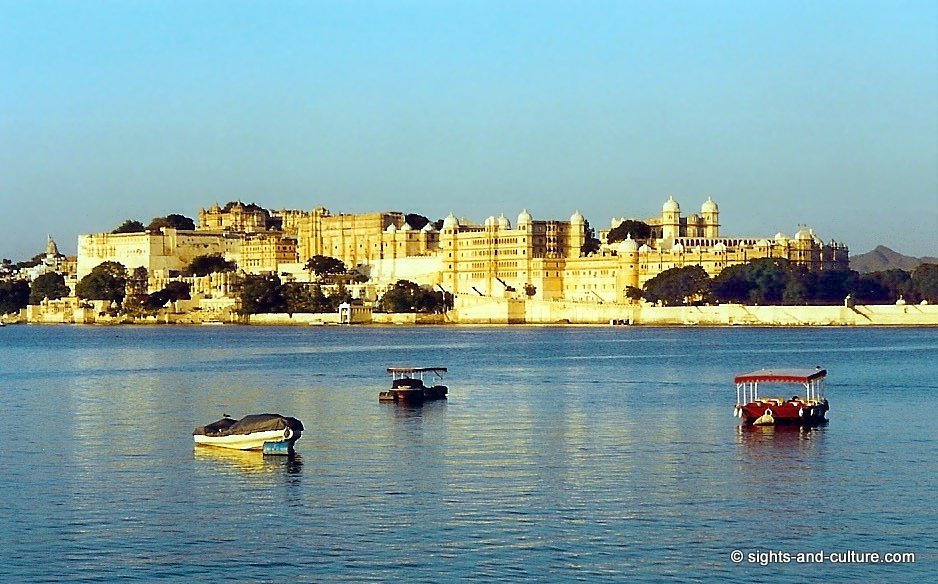
Udaipur is a unique place, called the "Venice of the East" - a white- and blue-shaded city built around the beautiful Lake Pichola and surrounded on all sides by serene mountains. It's also a very touristy town, and as such is just a very convenient place, with restaurants, fabric shops, tailors, email cafes and bookshops sprinkled throughout its narrow streets and charming alleyways. During our day-and-a-half there we visited the City Palace, an imposing structure which watches over and boasts beautiful views of the city as well as a labyrinthine series of halls and passageways in its interior. We also took a paddle-boat (screw those snobby rich tourists on their guided, motorized boat tours) out on Lake Pichola and got a closer look at Jagmandir Island and the luxurious, whitewashed Lake Palace Hotel, both situated in the middle of the lake, until we were ordered to cease, desist, and turn around by their respective security people. In fact, the Lake Palace Hotel was featured in the 1983 James Bond film Octopussy, approximately half of which was filmed in Udaipur. In one of the city's funnier idiosyncracies, more than 2/3 of the hotels in the area show endless reruns of the flick every single night at 7:00, one of which we caught.
When our time in Udaipur was over, on the evening of the 1st, I was very happy to have visited the place and experienced the city, but I didn't see much of a reason to stay for longer - it's just so touristy and, while it's very aesthetically pleasing, it's kind of a "been-there, done-that" place - I was eager to check out the sights, sounds and smells of Delhi.
(picture from goapassion.com)

Saturday, January 26, 2008

2 months in India

The first 5 months of my life post-high school have been spent in New Haven, Connecticut doing a Discipleship Training School with YWAM (Youth With A Misson) Axiom. The first 3 months of the school were dedicated to lectures and spiritual seeking while living in community, and during that time we took a week trip to Lancaster, PA (to stay with the illustrious Jim Ehrman), as well as a week working at an apple orchard in Centreville, Nova Scotia. The other two months were "outreach phase", with one month spent doing volunteer work in New Haven and New York, and the final month spent working at a children's home in Pune, India, southeast of Mumbai (Bombay).

The place we worked at in Pune was Hope of Glory, a Christian project taking in orphans and street kids from the city and giving them a home, education, and love, and we were able to help out by playing with the kids and taking some of the large workload off of the staff by taking care of the kids and doing cooking and cleaning around the home. There were 16 kids in the home, and they were all beautiful, sweet-spirited and loving people wh I will remember forever.

We flew into Mumbai on the night of December 31, just as they were celebrating New Year's Eve, then arrived early in the morning in Pune on the 1st of January, 2008. The outreach ended and our team left again from Mumbai on January 24, leaving us a measly 3 1/2 weeks in India. I really didn't like the idea of blowing the $3,000 cost of outreach (which was supported by incredibly generous friends and family) for such a pathetically brief period in such an amazing country, so I booked the ticket for my return flight out of Delhi on the 28th of February, which leaves me with almost 5 weeks to explore India with a backpack, a couple clothes, 4 disposable cameras, 32,000 rupees ($800 USD), 2 journals, 1 Lonely Planet "India" book, and no concrete itinerary. For the first 2 weeks until February 5 I am blessed to be travelling with Michael Cotton, who was one of the leaders of our outreach in Pune.

Anyway, on January 24 Michael and I said goodbye to the team and saw them off at the airport, a bittersweet parting and time to say farewell-for-now to some great friends that have made over the past 5 months. I'm very glad I did the DTS - I don't think I got as many theological answers or learned as much in the classroom as I thought I would, but I feel like I learned lots about family, community, and the importance of intimacy. After we left them at the airport at 20:00 PM we took a taxi to the Mumbai Central Train Station and found out which platform our train to Goa left from the next morning. It was late already and our train left early, at 6:55, so we slept in the train station, if "slept" is what you call it. It was pretty uncomfortable, but very memorable sleeping in the waiting room of the train station, but we boarded our train on time and got good seats. The train ride from Mumbai to Goa was great - extremely scenic, and certainly a must-do experience while in India. It was only marred by the fact that I ate some dosa which was a bit off, and my stomach revolted, resulting in numerous trips to the latrine and vomits off of the side of the train (to the immense enjoyment and laughter of the Indians in our train car). We arrived at the Old Goa train station of Karmali around 9:00 PM and quickly took a taxi into the hub city of Panaji. In Panaji we wandered around for a while searching for an available hotel since our planned lodging was full up for the night, until a strange man pulled up in a jeep and asked if we would like to stay at his place for the night since he had only 1 free room. We agreed out of desperation and were sped off to his place, where we collapsed in exhaustion.
This morning we woke up and rented a scooter from the proprietor of our hotel, a businessman overly interested in furthering his own assets, and spent the rest of the day exploring Panaji, a delightful city with a distinctive Portugese flavor, and zoomed north along the coast to check out Goa's trademark beaches.
EDIT: I'm sorry about the shoddy writing and the formatting and paragraph errors in this post- these internet cafe computers are as crappy as they are expensive to use.